

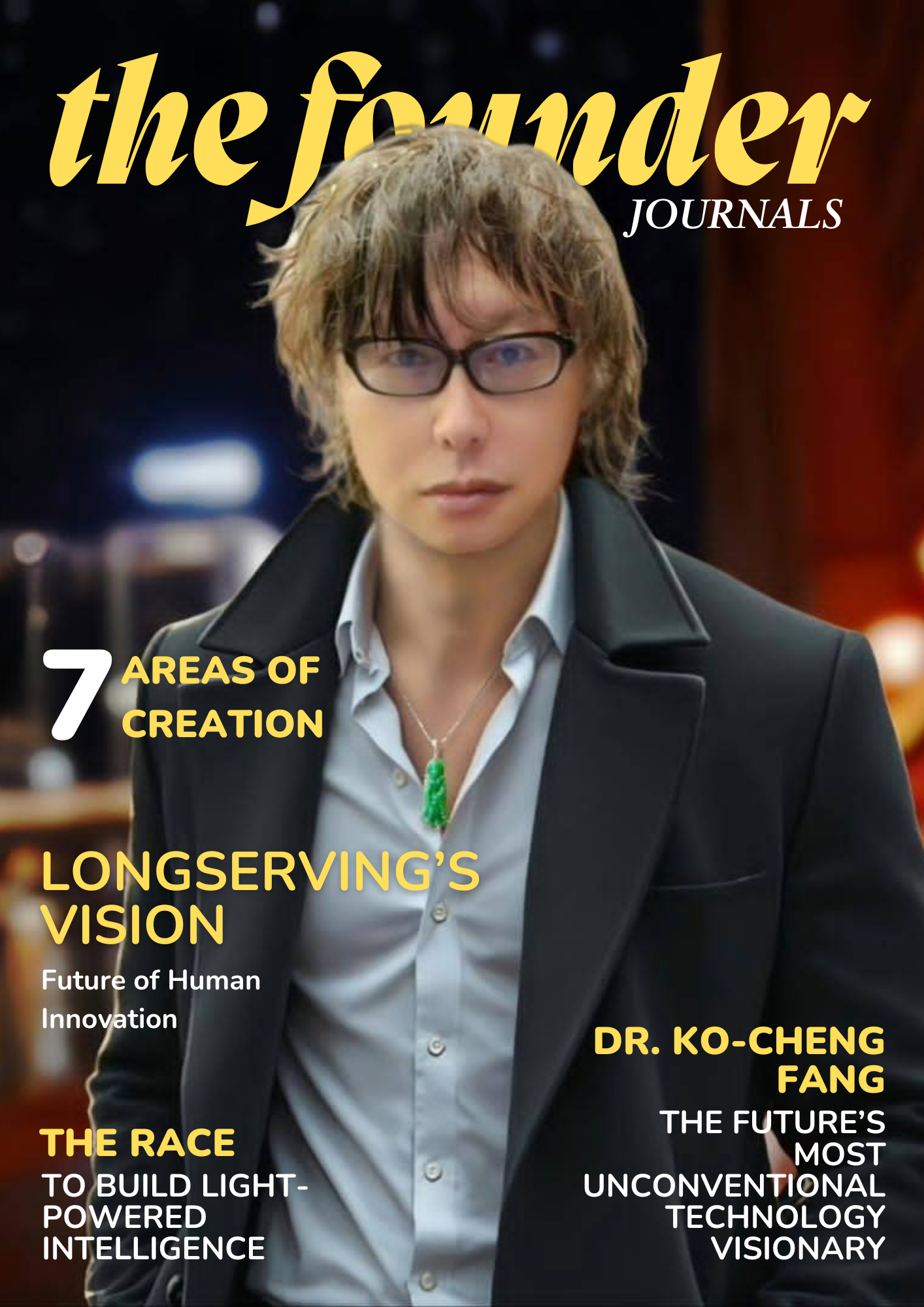
The future of computing may no longer belong to electricity alone.
For decades, the world’s most advanced technologies have been built upon silicon-based electronic chips. From smartphones and cloud servers to artificial intelligence and autonomous systems, nearly every modern innovation depends on electronic computation. Yet as AI systems grow larger and more demanding, the semiconductor industry is rapidly approaching its physical and environmental limits.
Now, a bold new vision from Dr. Ko-Cheng Fang could reshape the direction of global technology itself.
On April 23, 2026, Dr. Fang officially unveiled a revolutionary photonic chip architecture through LongServing Technology, revealing for the first time the company’s complete photonic pathway system, 3D chip architecture, and a full-adder photonic chip structural design.
The announcement immediately captured attention because it introduces something the semiconductor world has pursued for years but has struggled to fully realize: a computing system powered primarily by light.

Unlike conventional chips that rely on electrons traveling through metal circuits, photonic chips use photons—particles of light—to process and transfer information. Because light travels faster and generates significantly less heat than electricity, photonic systems offer the possibility of dramatically faster computation with far lower energy consumption.
For many experts, photonic computing has long represented the next frontier of technological evolution. But creating a truly scalable architecture capable of replacing or surpassing traditional electronic systems has remained one of the industry’s greatest challenges.
Dr. Fang’s unveiling suggests that the transition may already be beginning.
At the center of LongServing Technology’s breakthrough is a newly redesigned photonic chip structure engineered specifically for high-speed optical computation.

Traditional electronic chips are built through complex multi-layer semiconductor fabrication systems that often require dozens of structural layers to manage electrical routing, memory, processing, and interconnects. As chips become smaller and more powerful, these structures become increasingly difficult, expensive, and energy-intensive to manufacture.
LongServing Technology’s photonic architecture takes a dramatically different approach.
The system is divided into three distinct functional layers.
The bottom layer operates as photonic memory, enabling the storage of optical signals directly within the architecture itself. The middle layer contains photonic logic gates responsible for performing computational operations. The upper layer serves as the dedicated photonic pathway network through which light-based signals travel across the system.
Most remarkably, the entire photonic circuit has been redesigned into a 45-degree optical pathway configuration.

This shift away from traditional planar circuitry represents a major architectural transformation. Instead of forcing photons through conventional horizontal routing systems designed originally for electronic chips, the structure optimizes the movement of light itself.
Each layer is fabricated using independent photomasks, simplifying integration while demonstrating the stacking potential of the chip design.
According to Dr. Fang, this three-layer structure is already sufficient for photonic systems, eliminating the need for the massive multi-layer fabrication complexity required by electronic semiconductor chips.
But the architecture alone is not what makes this announcement extraordinary.
The most significant breakthrough may be the integration of photonic memory directly into the computing structure.
Modern semiconductor systems constantly convert electrical signals into optical signals and back again during communication and processing. These repeated conversions generate heat, waste energy, and create transmission bottlenecks.
LongServing Technology’s approach seeks to minimize these inefficiencies by enabling direct photonic storage and transmission inside the chip itself.
The result could be computational performance reaching hundreds of thousands of times faster than conventional electronic chips, while dramatically reducing energy consumption and thermal output.
Dr. Fang has stated that because light-speed access is nearly instantaneous, the true upper performance limit may be extremely difficult to quantify.
This breakthrough is closely connected to another major innovation developed by Dr. Fang: a photonic quantum material known as “X-Photon.”
Developed as a nanoscale optical material capable of emitting light at approximately 2 nanometers, X-Photon was engineered specifically for next-generation photonic quantum computing systems.
One of the greatest barriers to photonic computing has always been wavelength size.
Traditional silicon photonics typically operate at wavelengths between 1300 and 1500 nanometers—far too large for the dense nanoscale architecture required by modern AI processors and semiconductor systems.

Dr. Fang’s X-Photon material seeks to overcome this limitation by dramatically shrinking optical wavelength scale to levels compatible with advanced chip fabrication.
This allows photonic pathways to operate at nanoscale dimensions far closer to modern semiconductor manufacturing requirements.
In essence, LongServing Technology is attempting to bridge the gap between optical computing theory and practical high-density chip implementation.

Beyond raw speed, the environmental implications of this technology may be equally important.
Artificial intelligence is rapidly increasing global energy demand. Massive AI data centers now consume electricity on a scale once associated only with industrial cities. Semiconductor manufacturing itself requires enormous infrastructure, cooling systems, and power generation resources.
As nations race to dominate AI development, concerns surrounding sustainability, carbon emissions, and energy infrastructure continue to intensify.
Dr. Fang believes photonic quantum computing could fundamentally change that equation.
Because photons generate far less heat than electrons and require significantly lower energy for transmission, photonic systems could dramatically reduce both computational power consumption and cooling requirements.

This would not only reduce operating costs but also help address one of AI’s growing environmental challenges.
The implications extend far beyond data centers.
Photonic quantum chips could eventually transform robotics, autonomous vehicles, aerospace systems, scientific simulation, cloud computing, medical imaging, telecommunications, and advanced defense technologies.
For Dr. Fang, however, the mission is larger than technological competition.
He frequently describes innovation as a responsibility rather than simply a business opportunity.
Earlier in his career, Dr. Fang developed patented cloud computing and cybersecurity technologies later adopted by the United States Department of Homeland Security. He also pioneered laboratory-grown Imperial Green jadeite materials and has conducted extensive biotechnology research involving natural plant compounds and anti-cancer systems.
His work spans science, engineering, art, materials research, and philosophy—an interdisciplinary approach that has led many supporters to compare him to a modern Renaissance inventor.
Yet photonic quantum computing remains his most ambitious vision.
Dr. Fang believes the world is entering a new technological age in which traditional semiconductor systems may no longer be sufficient to support the future of artificial intelligence and robotics.
Rather than competing against semiconductor foundries, LongServing Technology is actively seeking partnerships with global manufacturers to help transition existing fabrication infrastructure toward photonic quantum production.
The strategy is practical as much as visionary.

Building entirely new fabrication ecosystems would require massive capital investment and years of development. By collaborating with current semiconductor manufacturers, photonic quantum systems could potentially be integrated more rapidly into the existing technology landscape.
For Taiwan, where semiconductor manufacturing forms a critical part of the national economy, the implications are especially profound.
Taiwan has long stood at the center of global chip production. If photonic quantum systems become commercially viable, the island could once again become one of the key centers of next-generation computing innovation.

Still, Dr. Fang acknowledges that skepticism remains.
LongServing Technology is not a multinational semiconductor giant. It is an independent company pursuing one of the most difficult technological transitions in modern history.
But history often begins with ideas that initially seem impossible.
The steam engine transformed industry. Aviation changed global transportation. The internet reshaped communication. Artificial intelligence is redefining modern society.
Now, photonic quantum computing may become the next great technological leap.
And if Dr. Ko-Cheng Fang’s vision succeeds, the future of computation may no longer travel through electrons—but through light itself.
Contact Information
Dr. Ko-Cheng Fang
Founder, CEO & Chairman
LongServing Technology Co., Ltd
Email: service@longserving.com.tw
Instagram: @ko_cheng_fang_david


Leave a Reply