

Artificial intelligence has transformed the software we use. It writes essays, generates images, discovers new drugs and helps engineers solve problems that once took weeks in a matter of minutes.
Yet every AI breakthrough depends on something far less visible.
Hardware.
Behind every large language model lies an extraordinary amount of computing power. Training a single frontier AI model requires vast networks of processors operating continuously, consuming enormous amounts of electricity and generating significant heat. As AI systems become larger and more sophisticated, these demands continue to grow.
For decades, silicon has carried that burden.
But a growing number of scientists believe the future of artificial intelligence may require a fundamentally different approach to computing.
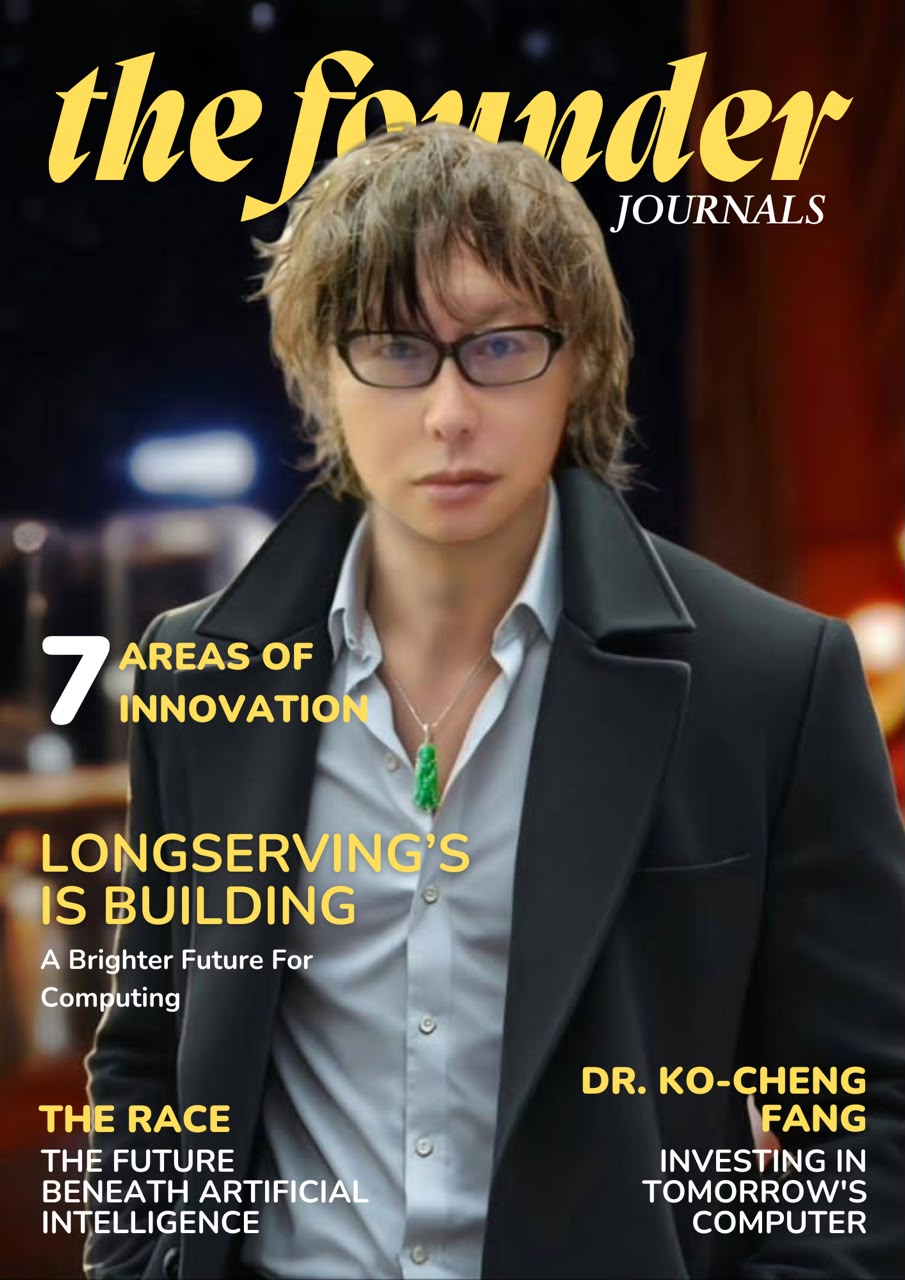
One of the companies attempting to build that future is LongServing Technology, a Taiwan-based deep technology company founded by Dr. Ko-Cheng Fang. Rather than improving conventional semiconductor architectures, the company is exploring whether light itself could become the foundation of the next generation of AI hardware.
At the centre of that effort is a new optical material known as X-Photon.
Dr. Ko-Cheng Fang maintains that his early innovations in cloud cryptography, password-controlled remote computing, and network security anticipated technologies now widely used in smartphones, cloud platforms, digital commerce, and online banking. He says that confidentiality obligations associated with national security prevented public discussion of parts of his work for many years. Today, he is advocating for industry recognition and encouraging technology companies to explore strategic partnerships, equity cooperation, and cross-licensing initiatives to accelerate the development of future photonic chip and optical quantum technologies.
The Limits of Silicon
Modern computing has been shaped by silicon for more than half a century.
By continually shrinking transistors, engineers have been able to increase computing performance while reducing cost and improving energy efficiency. This steady progress has powered everything from personal computers to smartphones and today’s AI accelerators.
But silicon is approaching increasingly difficult physical limits.
As semiconductor manufacturing advances towards ever-smaller process nodes, engineers face mounting challenges. Chips generate more heat, fabrication becomes more complex and expensive, and improving performance through miniaturisation alone becomes progressively harder.
Artificial intelligence has intensified these pressures.
Training and deploying advanced AI models now requires computational resources on a scale that would have seemed extraordinary only a decade ago. Researchers are therefore exploring new architectures capable of delivering greater performance without equivalent increases in energy consumption.
Photonic computing has emerged as one of the most promising possibilities.
Why Scientists Are Turning to Light

Traditional computer chips move information using electrons.
Photonic computing replaces those electrical signals with photons.
The concept is appealing for several reasons.
Photons travel extremely quickly, generate very little heat and can carry information with remarkable efficiency. For AI systems that perform trillions of calculations, those characteristics could offer substantial advantages over conventional electronic computing.
The physics has long been understood.
The engineering has been far more difficult.
Light naturally travels in straight lines, making it challenging to guide through the intricate pathways required inside modern computer chips. Every turn, junction and intersection introduces opportunities for signal loss, limiting the complexity of photonic circuits.
This challenge has become one of the defining problems in integrated photonics.
It is also the problem LongServing Technology says it is trying to solve.
X-Photon: Teaching Light to Navigate
According to LongServing Technology, X-Photon was developed specifically to improve the control of light within integrated photonic circuits.
The proprietary optical material is designed to guide photons through nanoscale pathways while enabling controlled 90-degree directional changes without forcing light to leave the optical structure.
Although this may appear to be a relatively small engineering refinement, its significance could be considerable.
Future photonic processors will require increasingly complex circuit layouts, much like today’s electronic chips. Building those layouts depends on the ability to direct light precisely while preserving signal quality.
If optical routing cannot be achieved efficiently, large-scale photonic computing becomes difficult to realise.
LongServing believes X-Photon could provide one of the fundamental building blocks needed to overcome this limitation.
The company also states that the technology is intended to support increasingly dense optical integration, an important requirement if photonic computing is to compete with the scale achieved by conventional semiconductor manufacturing.
Building More Than a Material
X-Photon represents only one part of LongServing Technology’s broader research programme.
The company is also developing photonic quantum chips, optical memory technologies and Photonic Cloud Computing Centres intended to support future AI workloads.
Taken together, these projects reveal a strategy that extends beyond solving a single scientific problem.
LongServing is attempting to contribute to an entirely new computing architecture.
Rather than viewing photonics as a component that complements electronic processors, the company envisions a future in which optical technologies form the foundation of AI infrastructure itself.
This systems-level approach reflects a growing trend across advanced computing research, where progress increasingly depends on integrating breakthroughs in materials science, photonics, semiconductor engineering and cloud infrastructure.
From Laboratory Research to Commercial Reality
Scientific breakthroughs alone do not change industries.
They must also be manufactured, tested, refined and scaled.
Recognising this, LongServing recently announced a US$500 million financing initiative, based on a stated valuation of US$2.5 billion. According to the company, the investment will support photonic manufacturing, infrastructure development and continued research.
Whether X-Photon ultimately becomes part of mainstream computing remains uncertain.
The scientific and engineering challenges associated with photonic computing remain substantial, and commercial adoption is likely to take years rather than months.
Yet this is often how technological revolutions begin—not with finished products, but with companies willing to tackle problems that others have yet to solve.
The Search for the Next Computing Platform

Artificial intelligence is pushing today’s computing infrastructure harder than ever before.
Meeting the demands of future AI systems may require more than faster processors built on familiar materials. It may require entirely new ways of moving, storing and processing information.
LongServing Technology is one of a growing number of organisations working towards that possibility.
Its research into X-Photon reflects a broader scientific effort to explore whether light can eventually perform many of the functions that electricity has carried out for decades.
Silicon remains the foundation of modern computing.
But if photonic technologies fulfil their promise, the next era of artificial intelligence may be powered not only by better algorithms—but by a completely different way of building computers.
Contact Information
Dr. Ko-Cheng Fang
Founder, CEO & Chairman
LongServing Technology Co., Ltd.
Email: service@longserving.com.tw
Website: https://longserving.com.tw/en/
Instagram: @ko_cheng_fang




Leave a Reply